How to Choose the Right NTC Thermistor for Your Needs?

Choosing the right Thermistor Ntc can be a challenging task. These sensitive components play a crucial role in temperature measurement and control. With various options available, understanding their specifications is essential.

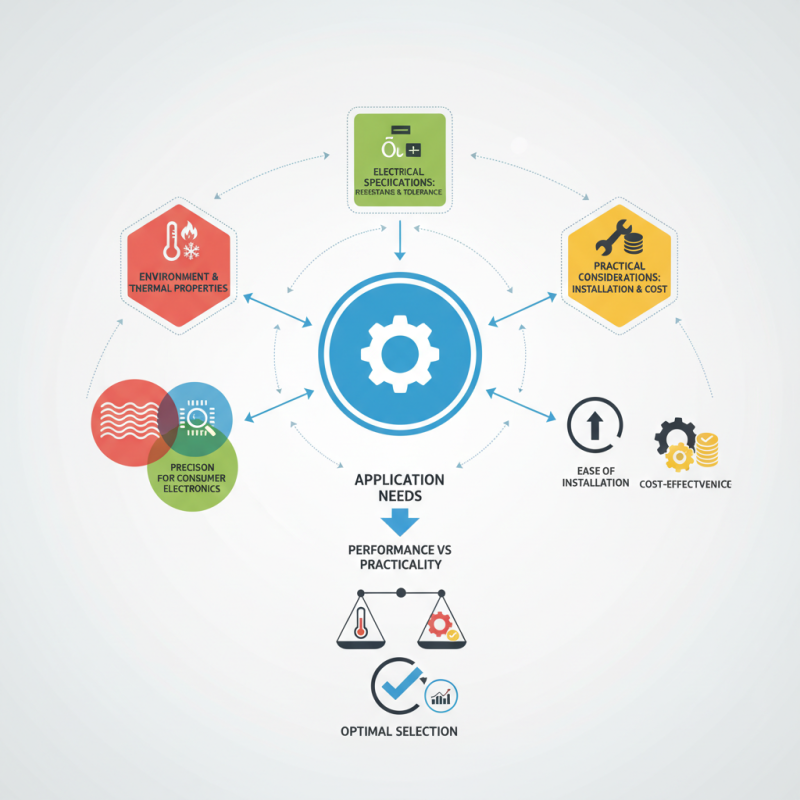
Thermistor NTCs vary widely in resistance, tolerance, and thermal properties. Each application demands specific characteristics, making it vital to match your needs. For example, industrial equipment might require robust thermistors that withstand harsh conditions. In contrast, consumer electronics may need smaller, more precise units.

In the face of these choices, one must consider the application's environment and requirements. Ease of installation and cost should not be overlooked either. Making the right selection involves balancing performance with practicality. Reflecting on these factors ensures that the thermistor NTC chosen is not only functional but also optimal for your specific situation.
How to Choose the Right NTC Thermistor for Your Needs?

Understanding NTC Thermistors: Basics and Functionality

NTC thermistors are crucial components in temperature sensing and control applications. They offer high sensitivity and stability in a compact design. These devices decrease resistance as temperature rises, enabling accurate readings in various conditions. Understanding their functionality helps users make informed choices.

When selecting an NTC thermistor, consider operational range and response time. The right thermistor should match your specific temperature needs. For instance, applications in HVAC systems may require different specifications than those used in automotive sensors.

Tip: Always consult technical datasheets for resistance-temperature characteristics. Pay attention to tolerance levels, as small variations can impact performance. Test your thermistor in real conditions to validate its effectiveness. A thermistor that works well in theory might not function optimally in practice.

Choosing an NTC thermistor is not just a matter of numbers. Evaluation of the environment where it will be used is essential. Factors like humidity and vibration can affect the thermistor's performance. Make sure to test different options to find the best fit for your application.

How to Choose the Right NTC Thermistor for Your Needs?

Parameter Example Value Description
Resistance @ 25°C 10 kΩ Nominal resistance of the thermistor at room temperature.
Beta Value (B25/85) 3950 K Characterizes the thermistor's temperature-resistance relationship.
Temperature Range -40°C to 125°C Operational temperature range for the thermistor.
Dissipation Constant 2 mW/°C Rate at which the thermistor can transfer heat to its environment.
Thermal Time Constant 10 seconds Time taken to reach approximately 63% of its final temperature.
Package Type Axial Lead Physical form factor of the thermistor.

Key Parameters to Consider When Selecting an NTC Thermistor

When selecting an NTC thermistor, focus on key parameters to ensure it meets your application needs. These parameters include resistance, temperature coefficient, and response time. The resistance at a specific temperature is critical. It dictates how sensitive the thermistor will be. A higher resistance usually means a more sensitive thermistor.

Temperature coefficient indicates how the resistance changes with temperature. This value is crucial for precise measurement or control. A thermistor with a larger negative temperature coefficient (NTC) will respond faster to temperature changes. Check the response time as well; it varies by application. A slower response might not be suitable for rapid temperature fluctuations.

Evaluate the material and construction of the thermistor too. The environment plays a role in the thermistor's performance. For example, some materials may degrade in high humidity. Consider where the thermistor will be used. Not all thermistors are built for every condition. This variability can lead to underperformance if not carefully assessed. Reflect on these factors to make an informed decision.

Types of NTC Thermistors and Their Applications

When selecting an NTC thermistor, understanding the types and their applications is crucial. NTC thermistors are essential in temperature measurement and control. Their resistance decreases as temperature rises, making them perfect for various applications. According to a report by Market Research Future, the global thermistor market is expected to grow by over 7% annually, reflecting their increasing importance.

There are two main types of NTC thermistors: bead and disk. Bead thermistors are small and ideal for quick response times in temperature sensing. They are often used in digital thermometers and HVAC systems. Disk thermistors, on the other hand, offer higher power ratings and stability. They are commonly found in appliances and automotive systems. Each type has distinct advantages, yet choosing the wrong one may lead to inaccurate readings or response delays.

Consider application-specific requirements, such as temperature range and environmental conditions. Some thermistors may not perform well in extreme environments. A 2021 industry survey indicated that 30% of users experienced failures due to improper thermistor choice. Understanding these nuances can help ensure reliable and accurate temperature measurements, ultimately enhancing system performance.

Tips for Evaluating Quality and Performance of NTC Thermistors

Choosing the right NTC thermistor affects the performance of your applications significantly. When evaluating thermistors, consider several crucial factors. One important criterion is the temperature coefficient. A typical NTC thermistor has a coefficient that ranges from -3% to -6% per degree Celsius. Higher coefficients indicate more sensitivity but can also lead to instability in certain environments.

Another essential aspect is the resistance tolerance. Quality thermistors should have a tolerance of 1% to 5%. This accuracy can be vital in precise applications like medical devices or automotive systems. An analysis by the Thermistor Association notes that a change in resistance of just a few ohms can drastically alter the output signal in such cases.

Durability is also a key factor. Look for components that withstand extreme temperatures and humidity. Testing reports suggest that thermistors with a lifespan rating exceeding 1,000 hours at high temperatures are more reliable. However, even high-rated models may still fail under stress, underscoring the need for robust quality assessments. It’s important to weigh these characteristics carefully, as thermistors are critical components in many technologies.

Best Practices for Integrating NTC Thermistors in Circuits

When integrating NTC thermistors into circuits, careful consideration is essential. One key aspect is selecting the appropriate resistor value. The resistance of an NTC thermistor decreases as temperature rises. This characteristic must align with the application requirements. For instance, if the thermistor is placed in a temperature-sensitive environment, it should provide accurate readings.

Placement of the thermistor in the circuit also matters. It should be situated close to the heat source but away from interference. This proximity can improve response times. Additionally, understanding the thermal mass of components around the thermistor can help optimize performance. You may encounter issues if the thermistor is too insulated or too exposed.

Calibration is vital to ensure accuracy. Every circuit has its nuances, and variations in component specifications can impact readings. Take time to test and adjust the circuit. Regularly check the thermal characteristics over time. Reflecting on potential drift will help maintain reliability. Ultimately, integrating NTC thermistors is a balance of precision and adaptability in dynamic conditions.